11/03/25
11 min
Florida Bicycle Accident Statistics: Crash Data Analysis
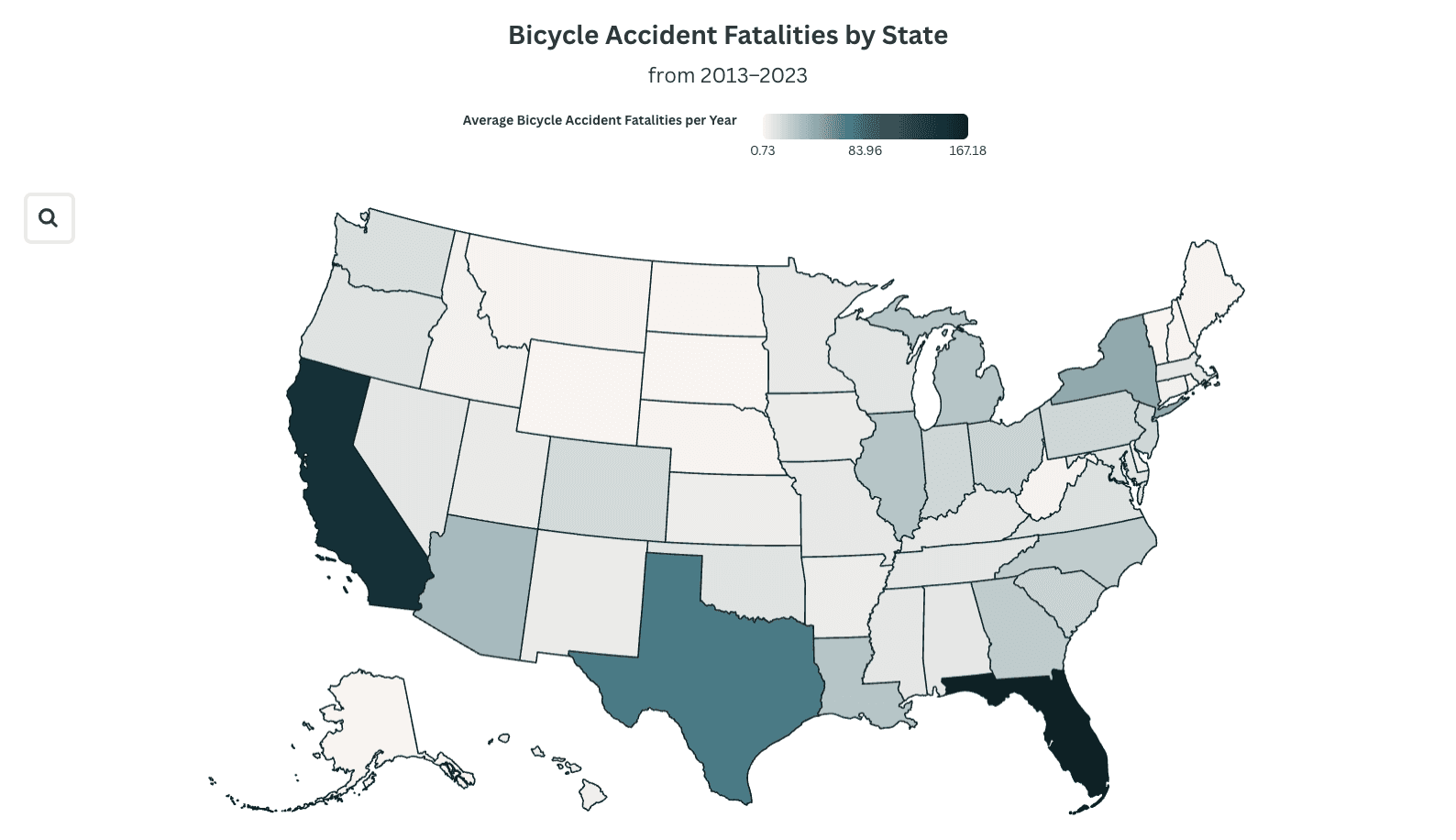
Table of Contents
Justice Simplified
Bicycle Accidents in Florida: Statistics & Implications
In the state of Florida, bicyclists share the rights and responsibilities of motorists and other road users. Much like anyone else, cyclists assume the risk of accident, but unlike most other vehicles, bicycles are particularly vulnerable in the event of a crash. These crashes can lead to severe injury, and in some of the worst cases, death. Getting caught up in a bicycle accident in Florida can be a disastrous event—but unfortunately, it is not necessarily an uncommon one.
In this blog, we’ll perform a detailed analysis of recent traffic data to uncover the prevalence of cyclist crashes in Florida. Throughout this discussion, we’ll highlight the most significant trends in the data and discuss possible implications. These Florida bicycle accident statistics lend critical insights on crash factors, and understanding them can help motorists, cyclists, and the state of Florida to better prioritize road safety for all.
How Does Florida Compare to Other States for Bicycle Fatalities?
The following data was gathered from the National Highway Traffic Safety Administration’s (NHTSA’s) Fatality and Injury Reporting System Tool. We specifically reviewed data on pedalcyclist crash fatalities by U.S. state, across a period from 2013 to 2023.
Our goal in obtaining and reviewing this data was to observe for ourselves how Florida measures up against other states when it comes to the risk of bicycle accidents. We discovered some serious implications for bicycle safety in Florida, as well as some helpful statistical guidance on how cyclists can best protect themselves from disaster.
Does Florida Have the Most Bicycle Fatalities from Vehicle Crashes?
Yes, evidence indicates that Florida does have the most bicycle fatalities from vehicle crashes, at least based on recent traffic data.
Top 10 Most Dangerous States for Cyclists
The bar chart below contains what we found to be the top 10 most dangerous states for U.S. cyclists, based on total number of fatalities from 2013 to 2023.
As reflected by the chart, Florida is ranked highest not only in total pedalcyclist fatalities (1,839), but also in highest number of fatalities in a single year (234, in 2023). Together with California, which ranks second with 1,624 fatalities, Florida pulls far ahead of the other states in the top ten, with third place going to Texas (778 fatalities—less than half of California’s total).
While California is not far behind in total fatalities (1,624) or highest fatalities in a single year (182, in 2022), the overall change in pedalcyclist fatalities from 2013 to 2023 actually indicates a slight decrease (-1.35%), indicating that California’s fatality rate has stayed fairly stable overall.
Florida, on the other hand, had pedalcyclist fatalities increase by 75.94% during the same period. While there are other states in the top 10 with much higher rates of change (the highest among all U.S. states, not counting those which started at 0 in 2013, is Oregon, with a 466.67% increase), Florida’s increase is still quite significant.
This is especially true when considering that this increase is from a starting number of 133, whereas a state like Louisiana only began with 14. Florida’s annual pedalcyclist fatalities increased by 1,706, while Louisiana’s increased by 291.
Overall, these statistics point to one concerning fact: Florida is the leading state for cyclist fatalities in the U.S., and this number seems to still be trending upwards.
Which Counties Are the Most Dangerous?
To look further into this question, we referenced data from the Florida Department of Highway Safety and Motor Vehicles (FLHSMV), which recorded different types of bicycle accidents in Florida by county.
Which Florida Counties Have the Most Bicycle Accidents Annually?
To start with, we reviewed the FLHSMV’s Traffic Crash Reports over a five-year period from 2019 to 2023 (the five most recent years for which traffic data has been finalized). We took a look at each county’s annual bicycle accidents as well as their fatality rates, putting together an average across this period.
The counties with the highest annual bicycle accidents are listed in the bar graph below:
Together, these averages make up almost 80% of Florida’s average annual bicycle crashes across the same period (5,757.40 crashes). However, this does not necessarily tell us the full story.
First of all, these top ten counties map on very closely to the top ten Florida counties with the highest population. Thus, just looking at the number of accidents alone isn’t enough.
Secondly, these figures cannot account for severity. While bicyclists are especially vulnerable compared to others on the road, not all bicycle accidents are made equal.
To get a better sense of which counties in Florida are the deadliest, we wanted to calculate the average fatality rate across this same five-year period.
Top 10 Deadliest Counties for Florida Cyclists
We narrowed our focus to exclude smaller counties, for which even a single accident can make a significant statistical difference, but may not actually be particularly significant to the bigger picture. To do this, we selected only counties which made up at least 1.49% (roughly 1/67) of the total bicycle accidents in all of Florida each year from 2019 to 2023. This left us with 16 counties to analyze. Of these counties, we picked out the top 10 deadliest based on the average fatality rate from bicycle accidents across this five-year period.
All 10 of these counties’ average fatality rates across this period are higher than Florida’s overall bicycle accident fatality rate of 2.81% over the same period. Added together, the bicycle accident fatalities from these ten counties make up around 40% of the total bicycle accident fatalities in Florida in this timeframe.
Contributing Factors to Bicycle Accidents in Florida
The data we’ve reviewed so far indicates that Florida is indeed one of the deadliest U.S. states for cyclists, but this leaves us with a question: why?
There are many factors that can contribute to bicycle accidents, whether minor or severe, including:
- Lack of proper infrastructure to support cycling (such as bike lanes)
- Poor environmental lighting
- Distracted or impaired drivers
- Excessive speeding
- Adverse weather or traffic conditions
All of these and more issues can contribute to bicycle accidents and cause greater damage. However, we want to specifically highlight some data shared by the FLHSMV’s Traffic Crash Report that sheds light on some of the most important factors in bicycle accidents in Florida.
The Role of Substance Use
The first factor we want to look at is the involvement of substance use in bicycle accidents. When impaired, drivers are less likely to notice cyclists nearby, or dangerous conditions in the area which could cause them to lose control of their vehicle.
While substance use is only confirmed in a small proportion of bicycle accidents in Florida, we can see that it is strongly represented when it comes to fatal accidents. Among the different types of bicycle accidents involving impaired driving, alcohol consumption has the lowest fatality rate, at 53.49%, however this is still almost 20 times the overall fatality rate for Florida bicycle accident, and 23 times the fatality rate for bicycle accidents without substance use.
This suggests that impaired driving may need to be a key area of focus in Florida in order to attempt to reduce the number of annual bicycle accident fatalities.
The Role of Safety Gear
The other critical factor we want to look at is the use of safety gear. Cyclists are already at a disadvantage on the road in the event of a collision, being smaller and lighter than most other vehicles on the road and without much insulation, they are left at an inherently greater risk of harm.
There are a few key details to take note of here, but the first we want to highlight is that bicycle accidents involving safety gear take up very small percentages of the total number of bicycle accidents in Florida for 2023. Specifically, we want to hone in on reflective clothing and good lighting, both of which promote safety by improving visibility, thereby reducing the likelihood of a collision.
These numbers indicate that wearing reflective clothing is an excellent protection against bicycle accidents in Florida. 98.72% of bicycle accidents in Florida in 2023 did not involve the wearing of reflective clothing—a staggering figure.
Additionally, we can surmise that one way for Florida to continue to address bicycle safety on public roads is by improving lighting conditions. The numbers strongly suggest that increased visibility greatly reduces the risk of accident.
Practical Takeaways
The data reviewed above comes with important implications for the state of Florida.
First and foremost, Florida appears to hold a strong lead over most other U.S. states when it comes to the fatality rate of accidents for cyclists. This is an issue that should be addressed to prevent unnecessary loss of life. Though a solution on the state level would certainly have to be multifaceted, and this data review is not expansive enough to cover every potential issue, there are a few key points to emphasize:
- Improving infrastructure for cyclists, especially lighting conditions on or near busy roadways.
- Employing preventative strategies, such as public education and strict enforcement, to discourage motorists from driving under the influence of any mind-altering substance.
- Improving public awareness around safety protocols for cyclists, including the importance of safety gear and staying in well-lit areas.
Practical Takeaways for Motorists
Motorists bear a key personal responsibility in mitigating the risk of bicycle accidents, fatal or otherwise. The following steps can contribute greatly to this responsibility:
- Always have a plan for transportation before using any mind-altering substances. Never drive impaired, under any circumstances.
- In addition, even without substance use, if at any point while on the road you feel that you are not in a safe state of mind to drive, it is wise to pull over as soon as it is safe to do so and come up with a plan from there.
- While driving, keep your eyes on your surroundings and avoid having distractions in the car. Be mindful of bike lanes and use your headlights in low-visibility conditions to improve your ability to spot cyclists on the road ahead.
Practical Takeaways for Cyclists
The data strongly indicates that cyclists should exercise an abundance of caution when traveling on roadways. The following steps may help reduce the likelihood or impact of a bicycle accident:
- Planning routes ahead of time, and primarily traveling on well-lit roads with convenient infrastructure for cycling, such as bike lanes.
- Always wearing reflective clothing, protective pads, and a helmet to improve visibility and protect your body in the event of a crash.
- Knowing your rights and responsibilities as a cyclist on Florida roadways.
In the event of an accident, there are a few important steps you can take in addition to the standard procedures on a standard accident checklist:
- Document evidence of the conditions at the time and location of the crash. Include weather and lighting conditions, as well as photos of injuries to your person or damage to any property, plus anything else that may indicate erratic or reckless driving on the part of the motorist.
- File a Florida accident report, which can not only help keep crash statistics thorough and accurate, but can also support a personal injury claim. Be sure to request a copy for your own records.
Final Thoughts
Just like any type of road safety, reducing the risk of bicycle accidents in Florida is not a one-man job. The data we’ve reviewed in this blog shows that Florida’s high rate of accident fatalities for cyclists is a multifaceted issue, and as such it will require a multifaceted solution. Both cyclists and others on the road have a role to play, as does the state itself. If each party commits to making a change, that commitment can be the first step towards a safer Florida for cyclists.
Sources:
- FLHSMV Crash Dashboard
- FLHSMV Traffic Crash Facts Annual Reports, 2019–2023
- Florida Statute 316.027
- NHTSA Fatality and Injury Reporting System Tool
